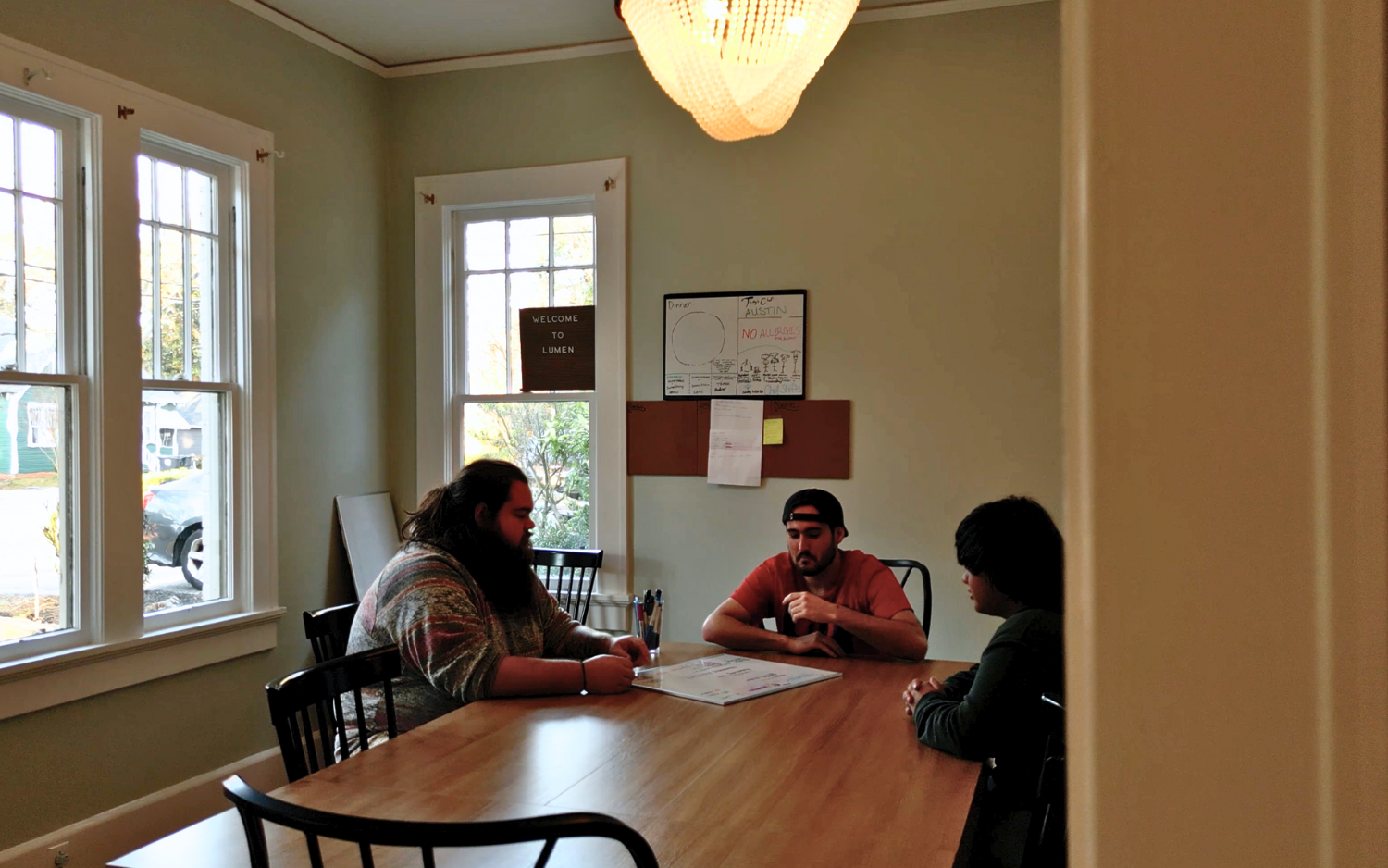
October is ADHD Awareness Month, but at Lumen, ADHD isn't something we only talk about in October.
We see it in the everyday moments that can make adulthood feel harder than it looks.
The missed appointment. The forgotten assignment. The job that started strong but became difficult to keep up with. The pile of laundry that somehow became completely overwhelming. The calendar with seventeen reminders that still didn't quite do the trick.
For a young adult, those moments can add up.
And sometimes, the problem isn't a lack of motivation or ability. It's that the systems around them aren't working for the way their brain works.
ADHD looks different in adulthood
ADHD is a neurodevelopmental disorder that can continue into adulthood. According to the CDC, an estimated 15.5 million U.S. adults had a current ADHD diagnosis in 2023, and 55.9% of those adults received their diagnosis at age 18 or older.
For many young adults, ADHD becomes more noticeable as the structure around them changes.
School may have provided a predictable schedule, reminders from teachers, and built-in support. Adulthood doesn't always come with those things.
Suddenly, you're responsible for figuring out when to wake up, how to get to work, when to pay the electric bill, what to buy at the grocery store, how to manage your schedule, and what to do when the plan inevitably changes.
That's a lot.
It's not about trying harder
One of the biggest things we work on at Lumen is helping young adults move away from the idea that they simply need to try harder.
Instead, we ask a different question:
What would make this easier?
Maybe it's a visual schedule.
Maybe it's setting an alarm for the first step instead of the entire task.
Maybe it's breaking a five-step responsibility into five separate tasks.
Maybe it's finding a better way to organize a workspace.
Maybe it's practicing the task alongside someone before doing it independently.
And sometimes, it's figuring out that the strategy that worked last month doesn't work anymore - and that's okay, too.
Building skills in real life
At Lumen, these aren't just conversations that happen in a classroom or coaching session.
We practice skills where they actually matter.
That might mean planning a week around work and social commitments. Learning how to prepare for an appointment. Figuring out how to manage money. Creating a morning routine. Navigating transportation. Communicating with an employer. Or simply learning what helps when everything starts to feel like too much.
The goal isn't to create a perfect system.
It's to help each young adult build a system that works for them.
ADHD and autism can overlap, too
ADHD and autism are different diagnoses, but they can occur together. Research has found significant overlap between the two, with one systematic review and meta-analysis estimating that approximately 28% of autistic people also have ADHD, although estimates vary depending on the population and how the conditions are assessed.
When autism and ADHD occur together, navigating everyday life can sometimes require an even more individualized approach.
Executive functioning, sensory needs, communication, routines, social relationships, and emotional regulation can all intersect in different ways.
Which is exactly why we don't believe a diagnosis tells us everything we need to know about a person.
We start with the person, not the diagnosis
At Lumen, we're not trying to make every young adult fit into the same system.
We're helping them figure out their system.
What are they good at?
Where do they get stuck?
What motivates them?
What environments help them thrive?
What support do they need right now—and what can they learn to manage more independently over time?
Those answers look different for everyone.
And that's the point.
Our work is centered around building self-efficacy and interdependence: giving young adults the opportunity to develop skills, make decisions, navigate challenges, and experience what it feels like to be capable.
Sometimes that means stepping in.
Sometimes it means stepping back.
And sometimes it means standing next to someone while they figure it out.
Independence doesn't mean doing everything alone
We don't think independence means never needing help.
Real adulthood doesn't work that way.
We all use calendars. We ask friends for advice. We set reminders. We outsource things we're not good at. We lean on people when life gets complicated.
For neurodivergent young adults, learning how to identify the support they need—and how to use it effectively - is an important part of becoming more independent.
That's the kind of independence we're working toward at Lumen.
Not perfection.
Not doing everything alone.
Just having the skills, confidence, and support to keep moving forward.
Finding what works
ADHD Awareness Month is a chance to learn more about ADHD, but it's also a chance to move beyond the stereotypes.
ADHD isn't simply being distracted.
And supporting someone with ADHD isn't simply telling them to make a list.
It's about understanding the person, figuring out where they're getting stuck, and finding practical strategies that make everyday life more manageable.
At Lumen, that's the work we get to do every day.
Not changing who someone is. Helping them figure out how they work best—and giving them the tools to build a life around it.
Sources & Further Reading
Centers for Disease Control and Prevention (CDC). Staley, B. S., Robinson, L. R., Claussen, A. H., et al. (2024). Attention-Deficit/Hyperactivity Disorder Diagnosis, Treatment, and Telehealth Use in Adults — National Center for Health Statistics Rapid Surveys System, United States, October–November 2023. Morbidity and Mortality Weekly Report, 73(40), 890–895.
This is the source for the 15.5 million U.S. adults with an ADHD diagnosis and 55.9% diagnosed in adulthoodstatistics.Lai, M.-C., Kassee, C., Besney, R., et al. (2019). Prevalence of co-occurring mental health diagnoses in the autism population: A systematic review and meta-analysis. The Lancet Psychiatry, 6(10), 819–829.
This is the source for the 28% pooled prevalence of ADHD among autistic people. Importantly, this is a pooled estimate across studies, so I'd keep the wording in the blog as “approximately 28%” rather than presenting it as a universal rate.Huang, Y., Arnold, S. R., et al. (2022). Cognitive, social, and behavioral manifestations of the co-occurrence of autism spectrum disorder and attention-deficit/hyperactivity disorder: A systematic review.